It’s Smart Making Your Smartphone Dumb: Here is the Evidence!
Although there is no doubt that smartphones have brought considerable convenience to our lives, many people—including me—find their frequent use detrimental to well-being and quality of life. It is therefore reasonable to ask whether limiting smartphone functionality could improve these outcomes.
This question was addressed in research by Noah Castelo and collaborators, who conducted a field experiment in which participants removed internet access from their smartphones (i.e., effectively turning them into “dumb” phones). The researchers found that this intervention improved sustained attention, mental health, and subjective well-being. Experimental designs are invaluable because they help disentangle cause and effect.
In this post, I review the study in detail and offer practical ideas for trying something similar at home.
How Was the Experiment Done?
The experiment lasted four weeks. Initially, all volunteers were randomly assigned to one of two experimental groups: an intervention group or a delayed intervention group.
Participants in the intervention group were instructed to download an internet-blocking app and block internet access on their smartphones for two weeks, while participants in the delayed intervention group used their smartphones as usual.
After two weeks, the delayed intervention group blocked internet access on their smartphones, while internet access was restored for the intervention group.
An objective measure of sustained attention, as well as self-reported measures of mental health and subjective well-being, were collected at three time points: before the start of the experiment (T1), two weeks later at the end of the first phase of the study (T2), and two weeks later at the end of the second phase of the study (T3).
This experimental design has several advantages:
-
Replication of findings: The effect of removing smartphone internet access was tested in two different groups, increasing confidence in the reliability of the results if similar effects were observed in both groups.
-
Measurement of post-intervention effects: The design allowed assessment of whether the effects persisted two weeks after the intervention ended and internet access was restored for the intervention group.
-
Ethical design: The delayed intervention group served as an initial control group while still benefiting from the intervention at a later stage.
What Did the Study Find?
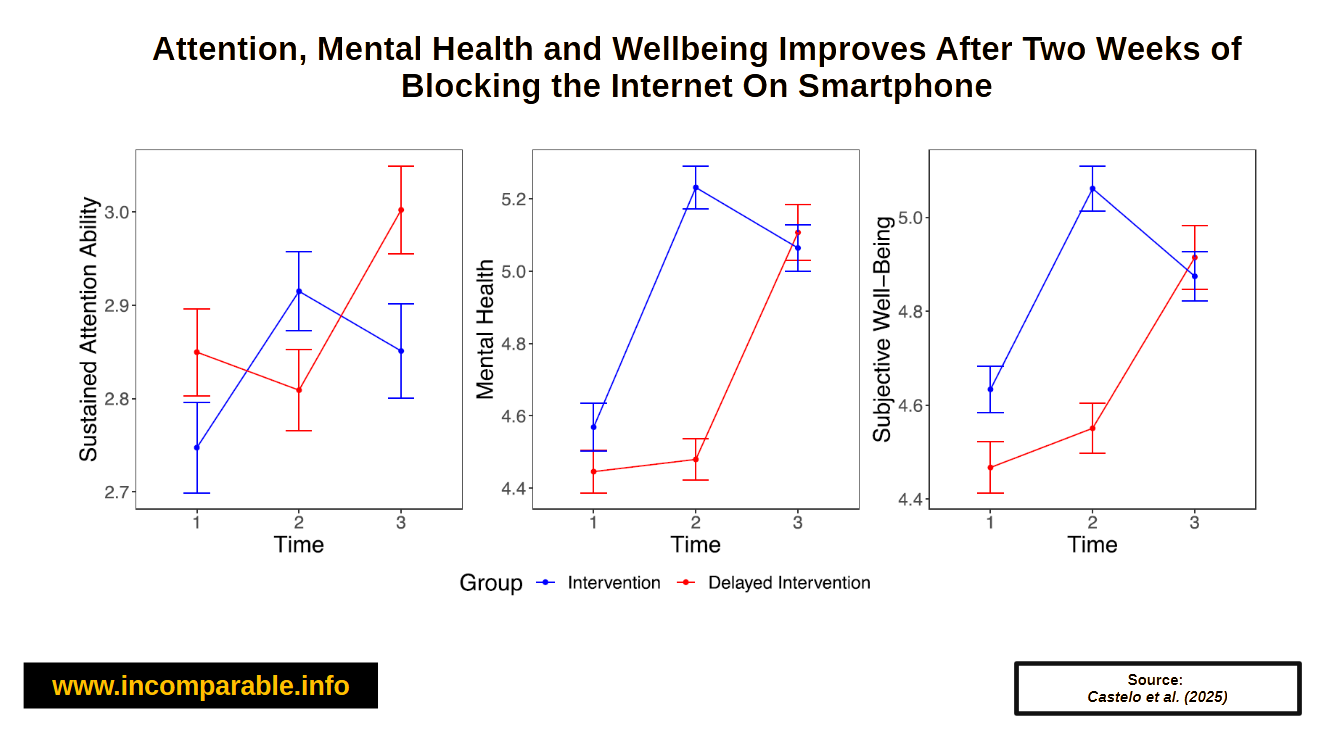
The study found that participants in the intervention group showed significant improvements in sustained attention, mental health, and subjective well-being after removing internet access for two weeks (T2). These improvements persisted two weeks after internet access was reintroduced on their smartphones (T3).
Results from the delayed intervention group confirmed the benefits of the intervention. Scores on the three psychological measures were similar during the two pre-intervention periods (T1 and T2) and showed significant improvement after internet access was removed (T3). See figure below.
Further Details (Click to Expand)
The graphs above show scores for sustained attention, mental health, and well-being across three time points (T1, T2, and T3). Participants in the intervention group blocked internet access from T1 to T2, whereas participants in the delayed intervention group blocked internet access from T2 to T3.
Results for the intervention group are shown in blue, and results for the delayed intervention group are shown in red. The dots represent the mean score for each group at each time point. The bars (known as error bars) show adjusted within-subject standard errors, which reflect the variability of participants’ scores across time while accounting for individual differences.
We interpret the graph descriptively as follows: if the error bars do not overlap, the difference between means is likely to be statistically significant; if the error bars overlap, the means are considered similar. Note that these data reflect the sample of participants in the experiment. To formally test for statistically significant differences in the population, inferential statistical tests are required (not shown in the graph). See Castelo et al. (2025) for further details.
How Big Was the Effect?
In the sustained attention task, accuracy in the intervention group improved from 2.75 at T1 to 2.91 at T2, then slightly declined at T3, two weeks after internet access on smartphones was reintroduced. In the delayed intervention group, mean accuracy was similar during the two periods with internet access (2.85 at T1 and 2.81 at T2) and then significantly improved following the intervention, reaching 3.00 at T3.
The authors estimated that the improvement in sustained attention was approximately one quarter of the magnitude of the difference typically observed between a healthy adult and an individual with ADHD.
Mental health significantly improved in the intervention group from 4.58 at T1 to 5.22 at T2 following the removal of internet access on smartphones, and then slightly declined to 5.08 after internet access was reintroduced. Mental health was measured on a scale from 1 to 7. In the delayed intervention group, a similar pattern was observed, with mental health significantly improving from 4.49 at T2 to 5.11 at T3 after internet access was removed.
The estimated effect of the intervention on depression was larger than the effect typically observed for antidepressant medication and comparable to the effect of receiving cognitive behavioural therapy (CBT).
Subjective well-being, also measured on a scale from 1 to 7, showed significant improvement in the intervention group from 4.65 at T1 to 5.05 at T2 during the intervention, followed by a significant decrease to 4.89 after internet access was restored. In the delayed intervention group, subjective well-being increased from 4.54 at T2 to 4.93 at T3 following the intervention.
What Can Explain the Results?
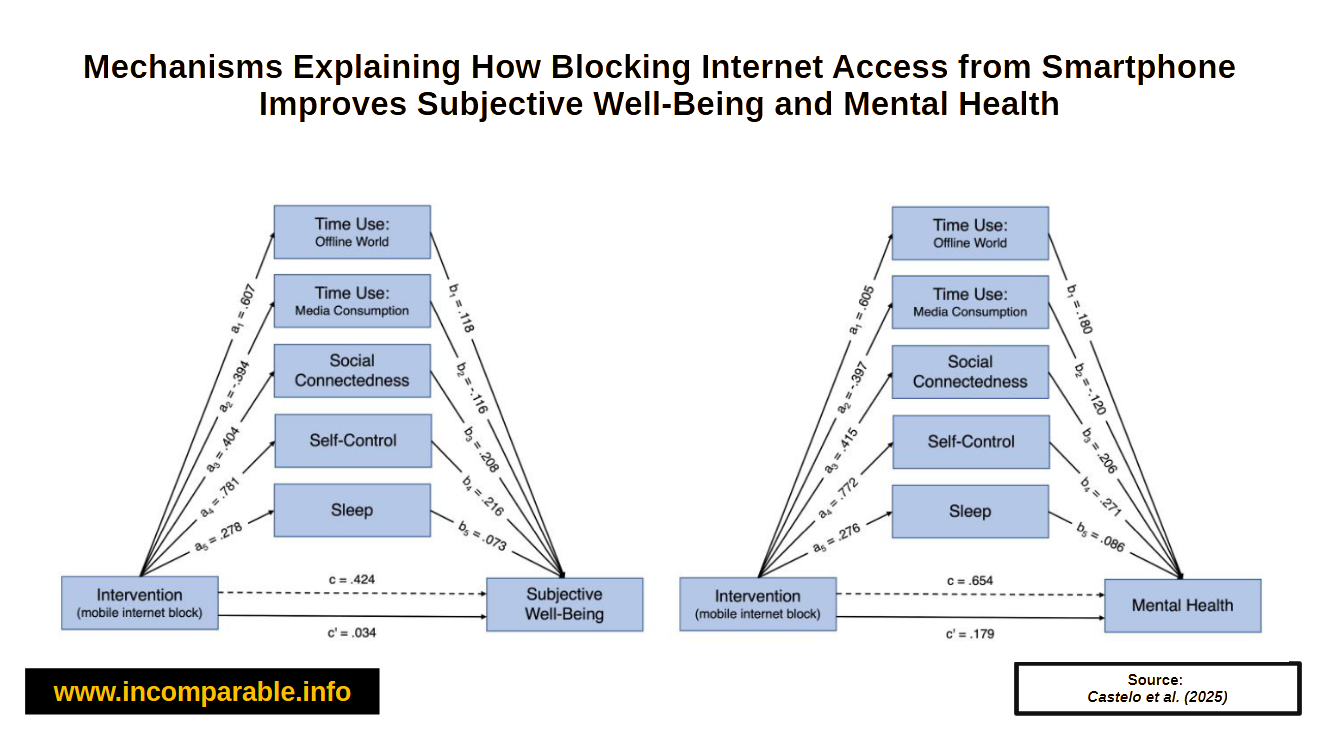
One strength of the study is that the authors investigated potential mechanisms that might explain the effects of the intervention. They considered five mechanisms through which removing internet access from smartphones might improve sustained attention, mental health, and subjective well-being:
-
Increased time spent in the offline world
-
Reduced time spent consuming media
-
Improved social connectedness
-
Improved self-control
-
Increased sleep
The results provided support for all five mechanisms.
Participants spent more time offline, consumed less media, and showed improvements in social connectedness, self-control, and sleep as a result of the intervention.
How to read this figure (click to expand)
The figure above illustrates mediation analyses for subjective well-being and mental health. Mediation is a statistical technique used to examine whether the effect of a predictor (in this case, the intervention) on an outcome (subjective well-being or mental health) can be explained by its effects on other variables, known as mediators (here, the five hypothesised mechanisms).
For mediation to be established, three conditions must be met: 1) The predictor significantly predicts the mediator, 2) the mediator significantly predicts the outcome, 3) adding the mediator to the regression model reduces the strength of the association between the predictor and the outcome.
If this reduction renders the predictor non-significant, the mediator is said to fully mediate the relationship between the predictor and the outcome. If the predictor remains significant but its effect is reduced, the mediator is said to partly mediate the relationship.
The figure shows evidence of mediation for both subjective well-being and mental health, as the direct effect of the intervention (c) is reduced when the mediators are included in the model (c′). The mediators fully mediate the relationship between the intervention and subjective well-being and partly mediate the relationship between the intervention and mental health. The results also found that the mediators fully mediated the relationship between the intervention and attentional awareness. However, there was no evidence of mediation for sustained attention when it was measured objectively.
Information about statistical significance is not shown in the figure. See Castelo et al. (2025) for further details.
Who Benefited the Most?
The authors reported that 91% of participants experienced positive effects on at least one of the following measures: mental health, subjective well-being, or sustained attention. However, blocking internet access on smartphones does not benefit everyone equally. For this reason, the authors examined whether the intervention produced greater benefits for specific groups.
They hypothesised that the intervention would lead to greater improvements in mental health and subjective well-being among individuals with higher levels of fear of missing out (FoMO), and greater improvements in sustained attention among individuals with more symptoms of Attention Deficit Hyperactivity Disorder (ADHD).
When these predictions were tested,
the results confirmed that participants with higher initial levels of FoMO experienced larger improvements in mental health and subjective well-being.
However, there was no support for the prediction related to ADHD symptoms: individuals with more ADHD symptoms did not show greater improvements in sustained attention following the intervention.
Didn’t We Know This Already?
Previous field experiments that asked participants to reduce or eliminate smartphone use have reported improvements in mental health and well-being. However, these studies relied primarily on self-reported measures of screen time and on participants’ willpower to reduce or eliminate smartphone use. In contrast, the study reviewed here required participants to block internet access using an internet-blocking app and tracked participants’ compliance through the same app, representing a clear methodological improvement.
It was also already known that reducing or batching smartphone notifications can improve self-reported attention. However, this study is the first field experiment to demonstrate that objectively measured sustained attention improves when smartphones have no internet access.
What Are the Limitations of the Study?
All scientific studies have limitations, and this study is no exception. One limitation is that participants were aware that they were taking part in a study examining the potential impact of smartphone use on well-being. As a result, placebo effects may have occurred, or participants may have responded in ways they believed aligned with the researchers’ expectations (i.e., demand characteristics).
In addition, the study did not include objective measures of time spent using other internet-connected devices, such as tablets or computers; this time was self-reported. Although smartphones are currently the primary means of accessing the internet and are particularly disruptive during social interactions (e.g., phubbing), participants may have substituted smartphone use with other devices to some extent during the intervention.
Another limitation is that the authors did not report whether participants experienced negative side effects. While the authors stated that most participants benefited from the intervention, it remains unclear whether those who did not benefit experienced adverse effects. This is an important consideration, as negative or aversive experiences have been documented in other interventions, such as psychotherapy or meditation, and short-term withdrawal effects are plausible.
Finally, the intervention was not tailored to individual participants. This limitation is understandable given the researchers’ goal of identifying causal relationships, which requires standardised interventions within experimental conditions. However, for individual-level, long-term improvements in sustained attention, well-being, and mental health, a more personalised approach—such as Cal Newport’s digital declutter—may be more appropriate and sustainable.
What Do We Still Not Know?
The follow-up period was conducted for only one group and lasted just two weeks. As a result, the longer-term effects of the intervention remain unclear. In the study, there was a slight decline in benefits two weeks after the intervention ended, suggesting that these effects may diminish over time if participants return to typical smartphone use.
Other studies have reported longer-term benefits—up to 4 months—following smartphone abstinence or a 1-hour-per-day reduction. However, these effects tend to be small.
Similarly, a 14-day intervention period may not be sufficient to produce long-lasting benefits. Habit formation is estimated to take approximately 66 days, suggesting that two weeks may be too short to support enduring behavioural change.
Furthermore, it is unclear whether this approach is suitable for everyone. Participants with poorer mental health were more likely to withdraw from the study after initially enrolling. This suggests that individuals who might benefit most from reduced smartphone use may struggle to adhere to the intervention, possibly because smartphone use serves as a coping mechanism for distress.
For some individuals, undergoing a digital detox like the one used in this study may be easier if social accountability is in place. For example, participants may benefit from reporting progress to a coach or participating in an accountability group where members encourage one another, share challenges, and report on their progress.
To reduce withdrawal effects, actively engaging in other pleasurable and healthier activities—such as in-person socialising and physical exercise—may be helpful. One study found that combining physical exercise with smartphone reduction led to earlier mental health benefits compared to smartphone reduction alone. For this reason, Cal Newport’s digital declutter protocol, which extends beyond a simple digital detox, may be more beneficial.
In my personal experience, engaging in enjoyable activities—such as spending time in nature, walking, going to the gym, socialising in person, and playing the guitar—as replacements for internet-based entertainment is fundamental to successfully reducing or eliminating smartphone use.
But… Smartphones also Have Benefits
Smartphones indeed have some benefits. In the study, participants retained access to some of the most beneficial smartphone functions, such as phone calls, text messages, and the camera. Nevertheless, it is the occasional and mindful use of these functions that likely provides the greatest value.
Some internet-based applications—such as navigation tools (e.g., Google Maps) or banking apps—may also be valuable. It is unlikely that allowing access to these specific applications would substantially alter the results, as they are probably not the primary drivers of the most detrimental effects of smartphone use.
Future research should examine whether similar benefits are observed when access to these types of applications is permitted.
Should I Try This at Home?
If you feel that your relationship with your smartphone is negatively affecting you, temporarily removing internet access on your smartphone to see what happens may be worth trying.
When I did this myself (in a more extreme form, as I also removed internet access at home), it was a life-changing experience. For this reason, I often recommend it.
If you are open to trying it, here are some general guidelines:
- Decide on a realistic timeframe. Choose a period during which you will remove internet access from your smartphone. If you have been using a smartphone intensively for several years, a longer timeframe (e.g., one or two months) may be more appropriate.
- Consider whether exceptions should be allowed. If you believe that certain applications—such as internet banking or ride-hailing apps—do not have detrimental effects, you may choose to keep them. However, if the goal is to improve well-being and focus, it is difficult to justify access to a web browser, app store, or social media on a smartphone.
- Plan alternatives. Decide what you will do instead of using your smartphone for entertainment. I find it helpful to carry a book and a notebook with me everywhere. Attending events, meeting friends, exercising, or trying new activities can also be highly stimulating.
- Do not rely solely on willpower. Use a reliable app blocker instead. Personally, I use the Minimalist Phone App (Android-only) to block distracting apps that cannot be uninstalled because they are pre-installed. In the study, Freedom was used for iPhone users.
- Take measurements before, during, and after. For example, you might rate (on a 1–10 scale) your satisfaction with how you use your time, your social relationships, and your overall happiness. You could also record screenshots of your smartphone usage from the previous one or two weeks (on Android, this information can be found under Settings → Digital Wellbeing). Alternatively, you could keep a journal, noting how you feel before removing internet access and tracking your activities, social interactions, and emotions during the experiment. This is the approach I used during my own experiment in June 2019.
- Reflect carefully at the end. Rather than returning to internet use as before, consider whether using the internet on your smartphone still makes sense for you. If it does, decide which internet-enabled apps are genuinely valuable and which are not. For example, you might find apps like Uber or Google Maps useful while choosing to use web browsing and social media only on a laptop.
Conclusion
The scientific study reviewed in this article shows that removing internet access from smartphones (i.e., making the smartphone “dumb”) improves sustained attention, mental health, and well-being. Adopting a similar approach may help you re-establish well-being in an increasingly hyper-distracting world.
About the Author
Ángel V. Jiménez is passionate about intentional living, scientific psychology, and the analysis of human behavior from an evolutionary perspective. He earned his PhD at the University of Exeter (UK), where he studied processes of status acquisition and interpersonal influence, with particular emphasis on the role of prestige in social learning. After completing his doctorate, he conducted postdoctoral research at Brunel University London and the University of Exeter. He currently teaches research methods for psychology.
Through this website, he shares practical, research-informed, and reflective content on intentional living and psychology, helping readers better understand human nature and make more deliberate choices in an increasingly complex and distracted world.
References
Main Paper
Castelo, N., Kushlev, K., Ward, A. F., Esterman, M., & Reiner, P. B. (2025). Blocking mobile internet on smartphones improves sustained attention, mental health, and subjective well-being. PNAS Nexus, 4(2). https://doi.org/10.1093/pnasnexus/pgaf017
Books
Newport, C. (2019). Digital minimalism: Choosing a focused life in a noisy world. Penguin.
Blog Posts
Jiménez, A.V. (2022a). The Diffusion of Mobile Phones and the Internet: A Personal Perspective. The Adventure of Success. Accessed on 4/12/2025
Jiménez, A.V. (2022b). Living Better with Less Technology: A Self-experiment. The Adventure of Success. Accessed on 4/12/2025
McLeod, S. (2023). Experimental Method In Psychology. Simply Psychology. Accessed on 15.12.2025.
NHS (2025). ADHD in adults. NHS. Accessed on 15.12.2025.
Psychology Today. Placebo. Psychology Today. Accessed on 15.12.2025.
Ruhl, C. (2023). Demand Characteristics In Psychology. Simply Psychology. Accessed on 15.12.2025.
Scientific Publications
Brailovskaia, J., Delveaux, J., John, J., Wicker, V., Noveski, A., Kim, S., Schillack, H., & Margraf, J. (2023). Finding the “sweet spot” of smartphone use: Reduction or abstinence to increase well-being and healthy lifestyle?! An experimental intervention study. Journal of Experimental Psychology: Applied, 29(1), 149-161. https://doi.org/10.1037/xap0000430
Farias, M., Maraldi, E., Wallenkampf, K. C., & Lucchetti, G. (2020). Adverse events in meditation practices and meditation-based therapies: a systematic review. Acta Psychiatrica Scandinavica, 142(5), 374-393. https://doi.org/https://doi.org/10.1111/acps.13225
Fitz, N., Kushlev, K., Jagannathan, R., Lewis, T., Paliwal, D., & Ariely, D. (2019). Batching smartphone notifications can improve well-being. Computers in Human Behavior, 101, 84-94. https://doi.org/https://doi.org/10.1016/j.chb.2019.07.016
Gupta, M., & Sharma, A. (2021). Fear of missing out: A brief overview of origin, theoretical underpinnings and relationship with mental health. World Journal of Clinical Cases, 9(19), 4881-4889. https://doi.org/10.12998/wjcc.v9.i19.4881
Eide, T. A., Aarestad, S. H., Andreassen, C. S., Bilder, R. M., & Pallesen, S. (2018). Smartphone Restriction and Its Effect on Subjective Withdrawal Related Scores. Frontiers in Psychology, Volume 9. https://doi.org/10.3389/fpsyg.2018.01444
Knausenberger, J., Giesen-Leuchter, A., & Echterhoff, G. (2022). Feeling Ostracized by Others’ Smartphone Use: The Effect of Phubbing on Fundamental Needs, Mood, and Trust. Frontiers in Psychology, 13, 883901. https://doi.org/10.3389/fpsyg.2022.883901
Kushlev, K., Proulx, J., & Dunn, E. W. (2016). “Silence Your Phones”: Smartphone Notifications Increase Inattention and Hyperactivity Symptoms. Proceedings of the 2016 CHI Conference on Human Factors in Computing Systems, San Jose, California, USA. https://doi.org/10.1145/2858036.2858359
Lally, P., van Jaarsveld, C. H. M., Potts, H. W. W., & Wardle, J. (2010). How are habits formed: Modelling habit formation in the real world. European Journal of Social Psychology, 40(6), 998-1009. https://doi.org/https://doi.org/10.1002/ejsp.674
Precht, L.-M., Mertens, F., Brickau, D. S., Kramm, R. J., Margraf, J., Stirnberg, J., & Brailovskaia, J. (2024). Engaging in physical activity instead of (over)using the smartphone: An experimental investigation of lifestyle interventions to prevent problematic smartphone use and to promote mental health. Journal of Public Health, 32(4), 589-607. https://doi.org/10.1007/s10389-023-01832-5
Vybíral, Z., Řiháček, T., Borovička, P., & Ogles, B. (2026). Clients’ negative experiences in psychological treatment. Current Opinion in Psychology, 67, 102175. https://doi.org/https://doi.org/10.1016/j.copsyc.2025.102175