
The Diffusion of Mobile Phones and the Internet: A Personal Perspective
Previously, I shared a historical look at the attention economy and its consequences on our lives. Here, I offer my personal experience with the diffusion of mobile phones and the internet.
The first version of this article was written and published on the 30th June 2019. The article captures my deep frustration with digital technologies and marks a turning point: I moved from using digital technologies mindlessly to intentionally adopting a digital minimalist perspective.
The next day, I began a month-long experiment living without a smartphone or home internet. I published the article on a blog for public accountability and to let key contacts know they’d need new ways to reach me.
I will cite this article quite a lot on this website, so it makes sense to have it here.
In this Article...
F
G
Once upon a time… The Diffusion of Mobile Phones
Before 1999, when I was 16, I didn’t know anyone with a mobile phone or an internet connection at home. This wasn’t a problem. I managed to meet my friends after school or during the weekends to do things together. We used different means, such as knocking on our friends’ doors, calling each other on the landline, or agreeing on a fixed place and time to meet. When we were far apart (e.g., on holiday), we communicated by post and by landline. This was the same way my parents and neighbours communicated with relatives and friends.
Things changed a bit when some of my friends acquired the mobile phones we call ‘dumbphones’ today (i.e., mobile phones without a touchscreen or internet access). These devices had two key differences compared to landlines.
- they were transportable and, consequently, it was possible to be available to answer phone calls all the time, and
- They permitted asynchronic communication via text messaging.
The fact that these phones were mobile had two important consequences for our group of friends. First, people with mobile phones had privileged communication with each other and could influence our social dynamics without being physically present (e.g., by calling us to stop what we were doing and meet them somewhere else). Second, people were less likely to plan in advance when and where to meet and began cancelling or postponing meetings at the last minute.
Text messaging affected people without mobile phones in a similar way to the first feature: their friends with mobile phones communicated more frequently without having to meet up. This was a social disadvantage for people without mobile phones, leaving them feeling left out. This, in turn, prompted them to buy one.
As the number of people with mobile phones increased, the pressure on those without to acquire one also increased. Additionally, the widespread use of mobile phones led to changes in how appointments and information were managed. For example, public offices, such as government agencies, began requesting mobile numbers to send security codes or schedule appointments by text message. Jobcentres, recruitment agencies, and private companies started to expect candidates and employees to be reachable on their mobile phones for timely communication about job offers, interview scheduling, or urgent information. These changes created not only social pressure but also institutional expectations for people to own a mobile phone.
The Diffusion of the Internet
The story of the internet’s diffusion is slightly different. Back in the day, most people didn’t pay for their own internet connection to use it at home. Instead, they used the internet at libraries, workplaces, schools, and cybercafés. My first contact with the internet was during high school, when, at around 15 (in 1998), we were taught to design websites.
Although the internet made it easier to access valuable information (e.g., resources for learning a second language), it also led to an explosion of useless and annoying content. For example, it was quite common to receive chain emails asking you to forward them to all your contacts, supposedly to bring you good luck in some domain (e.g., love and health) or to prevent a very bad thing from happening to you.
Fortunately for me, it took me 9 years to live in a house with the internet since my first encounter with it. During this time, I went to the local library to use their computer to surf the web. I used the internet mainly to download guitar tabs and articles. I saved these downloads on a floppy disk or printed them for later use at home. Using the internet in this way, I was online for one or two hours a week and used it to acquire information for the offline world. I think this was quite an effective use of the internet.
Caught
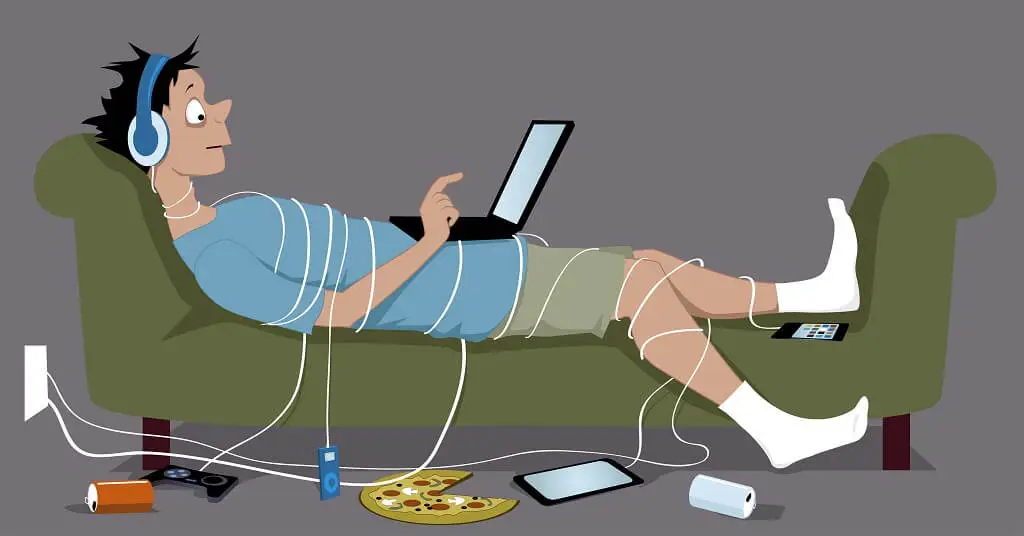
I resisted having a mobile phone for a long time (8 years!) after people around me started using them. During this time, I was even prejudiced towards people with mobile phones, who I saw as “posh people who buy things they don’t need.” Anyway, I ended up buying one when I moved into a house without a landline. As I was looking for a job, I needed a phone to be called for job interviews, which was the typical way to be contacted at the time (at least in Spain).
A year later, one of my housemates installed the internet. So, I stopped going to the library and bought a laptop to use the internet at home. My internet habits changed as a consequence. I stopped using the internet just as a way to acquire valuable information, which I had to make an effort to get (i.e., walk to the library and focus on collecting the information I needed in one hour). Instead, I started using the internet as a form of entertainment, consuming more and more of my time. I streamed films and video clips on websites such as YouTube; had prolonged and intermittent conversations via Messenger and Facebook; made online “friends” with common interests on MySpace; and tried to find love through dating websites such as Badoo.
These had two obvious consequences in my life:
- I wasted a lot of my precious time on low-value activities that I could have used for more creative, fun, and productive activities in the offline world, and
- I was frequently interrupted and distracted by constant notifications from Facebook and Messenger.
At the time, none of these negative effects bothered me…
Mindlessly Buying a Smartphone Wasn’t Very Smart
In 2007, the year I acquired my first mobile phone, Apple released the first iPhone, and, with it, mobile phones merged with the internet. Over the following years, more and more people have acquired smartphones, and these devices have an increasing number of applications. Before I acquired my own smartphone, I noted a remarkable change in people’s behaviour: people spent more and more time looking at these screens. I used to laugh at all these groups of people in cafés, who were browsing their smartphones instead of talking to each other. Nevertheless, I don’t think I understood the nature of what was going on until I bought a smartphone myself.
In September 2015, I moved to Durham (UK). Although I had lived abroad for most of the previous four years without needing a smartphone, I convinced myself it was necessary to keep in touch via WhatsApp, as was becoming common. Initially, I appreciated features like email, maps, dictionary, and news access on the go.
Later, I found myself being interrupted from what I was doing (e.g., studying or having a conversation) by continuous notifications from social media, emails, and so on; and scrolling through Twitter (now ‘X’), Facebook, or the news every time I was a bit bored, facing a challenge, or lacking motivation. My behaviour became different. Instead of enjoying what I was seeing with my own eyes (e.g., a beautiful landscape or a cool live performance), I felt I had to take a picture or video of everything, even though I rarely posted anything on social media. Every time I didn’t know something, I couldn’t wait and needed to know the “truth” immediately by asking almighty Google.
At some point, I became very aware of my problem when I didn’t go for a walk along the coast or dance salsa, which are things I really love, and instead stayed at home, entertained by the internet on my laptop or smartphone. Moreover, every time I replaced fun, productive, and interesting offline activities with merely entertaining online activities, I felt bad about myself. During these times, I always thought the same:
“I only have one life.
Is wasting my time on the internet how I want to live it?”
The Origin of the ‘Offline Diet’
My dissatisfaction with the role my smartphone and the internet were playing in my life led me to search for ways to have a healthier relationship with these technologies. My first step was to use an internet blocker to block my access to distracting websites such as online news outlets and Facebook during my time at work. My second step was to delete all my social media accounts, remove email apps from my smartphone, and turn off WhatsApp notifications.
Although these measures were useful to some extent, I kept returning to social media, and I still consumed a lot of news in my spare time. Because I felt bad about wasting my time on these things, I decided to try a more radical approach: to live without a smartphone and without internet at home and see what happens. I called this way of living ‘the Offline Diet’, as it seeks to maximise the time spent offline.
I report the results of that experiment and how I use the Internet today in the next article 🙂
About the Author
Ángel V. Jiménez is passionate about intentional living, scientific psychology, and the analysis of human behavior from an evolutionary perspective. He earned his PhD at the University of Exeter (UK), where he studied processes of status acquisition and interpersonal influence, with particular emphasis on the role of prestige in social learning. After completing his doctorate, he conducted postdoctoral research at Brunel University London and the University of Exeter. He currently teaches research methods for psychology.
Through this website, he shares practical, research-informed, and reflective content on intentional living and psychology, helping readers better understand human nature and make more deliberate choices in an increasingly complex and distracted world.

References
These are the materials consulted to prepare this article. Interested readers can review them to delve deeper into the topics discussed.
Jiménez, Á (2026). What Is the Attention Economy? Types & Consequences for Our Lives. Incomparable.
Jiménez, Á (2026). Living Better with Less Technology: My First Experiences. Incomparable.
Newport, C. (2019). Digital minimalism: Choosing a focused life in a noisy world. Penguin.
More Articles on Practical Philosophy

Did the Introduction of Facebook Cause a Rise in Depression and Anxiety?
Did the Introduction of Facebook Cause a Rise in Depression & Anxiety? It has become common to blame social media for the growing rates of depression and anxiety specially among young people over the past two decades. But… how can we be sure that social media caused...
