
How Acting on Values Improves Well-being and Life Satisfaction
One of the greatest challenges in crafting a meaningful life is not identifying our values, but consistently living by them.
When we fail to bridge the gap between what we believe and how we act, our sense of competence and authenticity begins to erode—taking our well-being with it.
For this reason,
it is not enough to reflect on our values; we must deliberately design systems that help us translate them into consistent action.
In this article, I examine an intervention study in which participants received structured values training and were encouraged to actively live out their values over a four-week period. The study was conducted by Agnieszka Bojanowska and her collaborators.
In this Article...
F
G
How was the study conducted?
258 participants completed the study. They were recruited through Polish universities and Facebook advertisements.
The study lasted four weeks. Participants were randomly allocated to one of three groups: the acting on values group, the mindfulness group, and the control group.
All participants completed a questionnaire before and after the intervention, which measured their levels of:
-
Eudaimonic Well-being (a form of happiness focused on functioning at one’s best, rather than just seeking pleasure)
-
Positive Affect (experiencing positive emotions)
-
Negative Affect (experiencing negative emotions)
-
Life Satisfaction (a global evaluation of one’s own life)
Participants in the acting on values group first completed a values questionnaire based on Schwartz’s basic human values research (this is similar to what the authors of the Life Crafting intervention I reviewed here did) and then received feedback on their four most important values.
Every week, they received a different text to read that trained participants on:
-
the role of values in people’s lives,
-
the advantages of knowing one’s value hierarchy and acting accordingly,
-
the factors influencing which values are most important to people, and
-
the importance of regularity acting on values.
After reading these materials each week, they planned the actions to take to implement one of their values for the upcoming week. Participants also reported the actions they had taken and their success in weeks 2-4.
The mindfulness group underwent a similar intervention. In this case, they completed a mindfulness questionnaire and received feedback on their mindfulness level. The levels were based on their questionnaire scores (early beginner, beginner, intermediate, and advanced) and included information on the advantages of mindfulness training.
Each week, participants in this group received a text to read as part of their mindfulness training:
-
what is mindfulness, and how it is practiced,
-
the advantages of practicing mindfulness,
-
mindfulness in different cultures—the Eastern and Western perspectives on attentive awareness,
-
information on the negative consequences of being in an unaware state of mind, and how to enhance motivation to practice mindfulness.
They also did one meditation each week (body scanning, sitting with the breath, sound, and walking meditation) and reported their plans for this week’s practice and their level of success in the previous week.
The control group simply completed the pre- and post-intervention questionnaires without receiving any training.
What Were the Results of the Study?
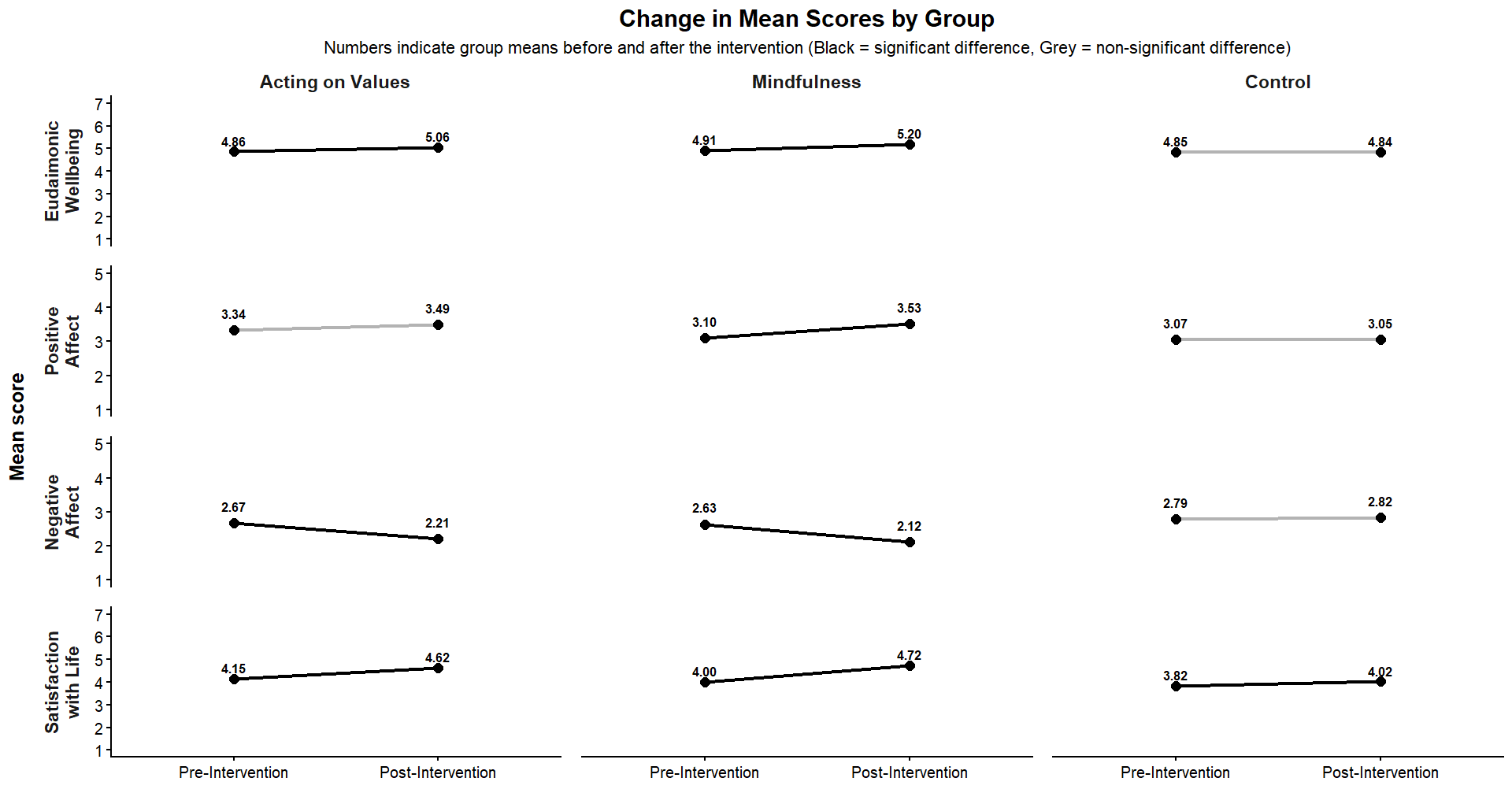
The graph below shows the group means before and after the intervention for each group: Acting on Values (first column), Mindfulness (second column), and the Control group (third column).
Further Details (Click to Expand)
The figure illustrates changes in mean scores from pre- to post-intervention across three groups—Acting on Values, Mindfulness, and Control—on four psychological outcomes: eudaimonic well-being, positive affect, negative affect, and life satisfaction.
Each column corresponds to one group, and each row corresponds to an outcome. Within each panel, the left point represents the pre-intervention mean, and the right point represents the post-intervention mean, with values labelled directly above each point. The connecting line indicates the direction and magnitude of change over time. Black lines denote statistically significant changes, whereas grey lines indicate non-significant differences.
I have created the figure with the data gathered by Agnieszka Bojanowska and her collaborators
It is clear that the intervention improved scores on the four measures in both the Acting on Values and Mindfulness groups, whereas scores in the control group changed little.
Let’s look at the figures in more detail. If we pay attention to the first column, we can see that
the scores for the Acting on Values group improved in all the measures.
Eudaimonic Wellbeing increased from 4.86 to 5.06, Positive Affect from 3.34 to 3.49, and Satisfaction with Life from 4.15 to 4.62, while Negative Affect decreased from 2.67 to 2.21. The differences between pre- and post-intervention scores were statistically significant in all the measures, except for Positive Affect, which approached statistical significance.
The Mindfulness group followed a similar pattern of results as the Acting on Values group.
In this group (second column in the graph), all measures significantly improved: Eudaimonic Wellbeing moved from 4.91 to 5.20, Positive Affect from 3.10 to 3.53, Negative Affect from 2.63 to 2.12, and Satisfaction with Life from 4 to 4.27.
In contrast, the control group’s scores hardly changed (third column in the graph). Eudaimonic Wellbeing moved from 4.85 to 4.84, Positive Affect from 3.07 to 3.05, Negative Affect from 2.79 to 2.82, and Life Satisfaction from 3.82 to 4.02. Nevertheless, the difference in Satisfaction with Life was statistically significant in the control group, but the change was much smaller than in both the Acting on Values and Mindfulness groups.
When the authors compared the results of the two intervention groups, they found no statistically significant differences between the Acting on Values and Mindfulness groups, indicating that both interventions were similarly effective in improving well-being and life satisfaction.
What are the strengths of the study?
The study has several strengths. First, the Acting on Values intervention was compared with a control group. That is, a group of participants who filled the different psychological scales at the two time points without receiving any training. This is a strength because it permits control for time effects.
Second, the acting on values group was not only compared to a control group but also to a mindfulness group. Mindfulness is a well-known intervention for improving well-being; therefore, it makes sense to compare this novel intervention with it to see whether acting on values meets the mindfulness standard.
Third, the design includes both pre- and post-measures for each individual and across three conditions, allowing us to compare whether the groups were similar from the start and whether the intervention caused the change in average scores in both intervention groups.
What are the limitations of the study?
However, the study also has important limitations. To start, there was no measurement of the intervention’s long-term effects. So, we cannot know whether the intervention’s effects are sustainable over time. It does not seem so. A related study with a different Acting on Values intervention showed that the positive results persisted for up to 2 weeks. However, well-being levels returned to baseline in the 3rd week. This suggests that it is necessary to continuously act on values to maintain their well-being benefits.
Another important limitation is the lack of exploration of individual variation within each group. From my point of view, it would have been interesting to explore the role of actually acting on values in the results, rather than just being a member of the novel intervention group and filling in the forms each week.
Although the intervention was successful in improving well-being, it is possible that delivering it in person rather than online would have led to better results. As the authors acknowledge, previous research has found that positive psychology interventions are more effective when they are delivered face-to-face than online.
Lastly, participants in the study were members of the general population. It is unclear whether the intervention would be similarly beneficial for people who suffer from major depression or general anxiety.
How Can I Get the Well-Being Benefits of Acting More on My Values?
From my point of view, the first step to act more in line with our values is to identify our core values. To do this, you need to carefully reflect on what matters to you. Good clues are things that make you happy or angry. For example, I know I care a lot about freedom because many of the conflicts I have with other people stem from feeling coerced into doing something against my will.
To identify your core values, you could also use a list of values or fill in a value questionnaire to identify your top 3-5 values, as the participants in the study did. If you struggle with this, feel free to reach out.
After identifying your values, it would be useful to write a few paragraphs on why these values matter to you. So, you can read it when you need a reminder of your whys.
Once the first two steps are done, it is time to act on your values. A way to implement this would be to plan your week on Sunday or early Monday morning, read what you wrote about your values, and plan what you will do to act on them that week. This would be similar to a to-do list, but instead of just bullet points with actions, you would have top-level headings with your values, and bullet points with actions for each value.
For example, one of my core values is competence or self-improvement in areas that are important to me, such as my career or social relationships. So, my weekly to-do list includes actions that will help me further develop those skills, such as “asking for feedback regarding an article I’ve written on this website” or “engaging in conversation with three strangers”.
For many people, however, it could be much easier to identify areas of their lives that are important to them (e.g., health, family, career), write about why these areas are important to them and what they want to achieve in them, and then plan weekly actions to advance in each of these areas.
I personally find this second approach more intuitive and easier to place on a to-do list.
Conclusion
In this article, I have reviewed research showing that acting on one’s values is as effective as mindfulness in improving well-being and life satisfaction. I have focused on group-level results. In the next article, I will explain how to interpret individual variation in the results of interventions like this one and why doing so can help us develop a more realistic view of self-improvement. To illustrate it, I will use the data from this study.
About the Author
Ángel V. Jiménez is passionate about intentional living, scientific psychology, and the analysis of human behavior from an evolutionary perspective. He earned his PhD at the University of Exeter (UK), where he studied processes of status acquisition and interpersonal influence, with particular emphasis on the role of prestige in social learning. After completing his doctorate, he conducted postdoctoral research at Brunel University London and the University of Exeter. He currently teaches research methods for psychology.
Through this website, he shares practical, research-informed, and reflective content on intentional living and psychology, helping readers better understand human nature and make more deliberate choices in an increasingly complex and distracted world.

References
These are the materials consulted to prepare this article. Interested readers can review them to delve deeper into the topics discussed.
Main Study
Bojanowska, A., Kaczmarek Ł, D., Urbanska, B., & Puchalska, M. (2022). Acting on Values: A Novel Intervention Enhancing Hedonic and Eudaimonic Well-Being. Journal of Happiness Studies, 23(8), 3889-3908. https://doi.org/10.1007/s10902-022-00585-4
Blog Articles
Jiménez, ÁV (2026). Life Crafting: A Novel Intervention to Increase Meaning in Life. Incomparable.
Books
Kabat-Zin, J. (2009). Full Catastrophe Living: Using the Wisdom of Your Body and Mind to Face Stress, Pain, and Illness. Random House Publishing Group.
Scientific Publications
Bojanowska, A., & Piotrowski, K. (2019). Values and psychological well-being among adolescents – are some values ‘healthier’ than others? European Journal of Developmental Psychology, 16(4), 402–416. https://doi.org/10.1080/17405629.2018.1438257
Bojanowska, A., & Zalewska, A.M (2016). Lay Understanding of Happiness and the Experience of Well-Being: Are Some Conceptions of Happiness More Beneficial than Others? Journal of Happiness Studies 17, 793–815. https://doi.org/10.1007/s10902-015-9620-1
Kłym-Guba, M., & Karaś, D. (2018). Polish version of the Questionnaire for Eudaimonic Well-Being–three factors rather than one. Health Psychology Report, 6(3), 273-283.
Koydemir, S., Sökmez, A.B. & Schütz, A. A Meta-Analysis of the Effectiveness of Randomized Controlled Positive Psychological Interventions on Subjective and Psychological Well-Being. Applied Research in Quality of Life 16, 1145–1185 (2021). https://doi.org/10.1007/s11482-019-09788-z
Russo-Netzer, P., & Atad, O. I. (2024). Activating values intervention: an integrative pathway to well-being. Frontiers in psychology, 15, 1375237. https://doi.org/10.3389/fpsyg.2024.1375237
Sheldon, K.M., Krieger, L.S. Walking the talk: Value importance, value enactment, and well-being. Motivation and Emotion 38, 609–619 (2014). https://doi.org/10.1007/s11031-014-9424-3
Schwartz, S. H., Cieciuch, J., Vecchione, M., Davidov, E., Fischer, R., Beierlein, C., Ramos, A., Verkasalo, M., Lönnqvist, J.-E., Demirutku, K., Dirilen-Gumus, O., & Konty, M. (2012). Refining the theory of basic individual values. Journal of Personality and Social Psychology, 103(4), 663–688. https://doi.org/10.1037/a0029393
