
Living Better with Less Technology: A Life-Changing Self-Experiment
Previously, I wrote about my struggles with technology use, feeling it impaired my productivity, social skills, and well-being. To address this, I ran a one-month self-experiment inspired by Cal Newport’s digital declutter, in which I:
-
replaced my smartphone with a dumbphone,
-
didn’t use the internet at home, and
-
blocked distracting websites when working with the laptop at the office.
This self-experiment was life-changing, and it is why I remain very cautious about the use of digital technologies.
In this article, I present the outcomes of a self-experiment with internet restrictions and two later experiences under even greater limitations, all between June 2019 and May 2020. The original article was written in May 2020. I have included a brief update on my current use of digital technology at the end.
In this Article...
F
G
1-Month Self-experiment
The self-experiment took place in July 2019, when I was conducting research at the university for my PhD thesis and living in Penryn, a small town of around 7,000 inhabitants in Cornwall, UK.
This month,
I put my smartphone in a university locker and replaced it with an older mobile phone without an internet connection. I also stopped using the internet at home and blocked distracting websites, such as social media and online news, with an internet blocker while working on the laptop at the office.
To communicate with important contacts, I used email (on a laptop at work), SMS, phone calls (both from a dumbphone), and Skype (on a laptop in a meeting room at the university).
I expected that this change would lead to improvements in my productivity at work and outside work, sociality, and well-being.
To see whether I was right, I used a notebook to track my productivity, social interactions, and happiness throughout the month. I was very exhaustive at the beginning, meaning I took notes about what I did every day. Later, I reduced the frequency to approximately once a week.
Why did I expect my productivity to improve?
For the purposes of the self-experiment, the term ‘productivity’ refers to my subjective perception of using my time well both at work and in my personal life. My expectation of improved productivity was the logical consequence of my previous experiences:
When I didn’t have internet at home or on my phone, I used it in a minimalist, highly functional way: I went to the library for one or two hours per week to collect the information I needed for my offline life. In contrast, when I had internet at home and on my phone, my use of the internet became much less efficient: I got easily distracted and wasted precious time.
Did my productivity really improve?
At the end of the self-experiment, I concluded that my productivity had increased. The improvement in my productivity was SPECTACULAR in the first week. For example, on the second day, I
-
Got up at 5 am
-
Walked to the office and arrived at 6.20 am
-
Worked very focused. I was at the office for only 6 hours and made lots of progress in my research
-
Went to the gym
-
Went for a coastal walk
-
Played the guitar
-
Cooked dinner and lunch for the following day
-
Went to dance salsa in the evening
The other days of the week were similarly productive both at work and outside work. Outside work, my time was occupied by activities such as swimming in the sea, reading on the beach, hiking, going to the gym, participating in a music improvisation workshop, brainstorming business ideas, and doing domestic chores. Although I had done some of these activities before the experiment, I had never been able to use my time so effectively:
I was at the office for fewer hours but worked better, while my life was filled with many interesting activities. I think this was the first time I experienced what I later called “the virtuous cycle of focused work”.
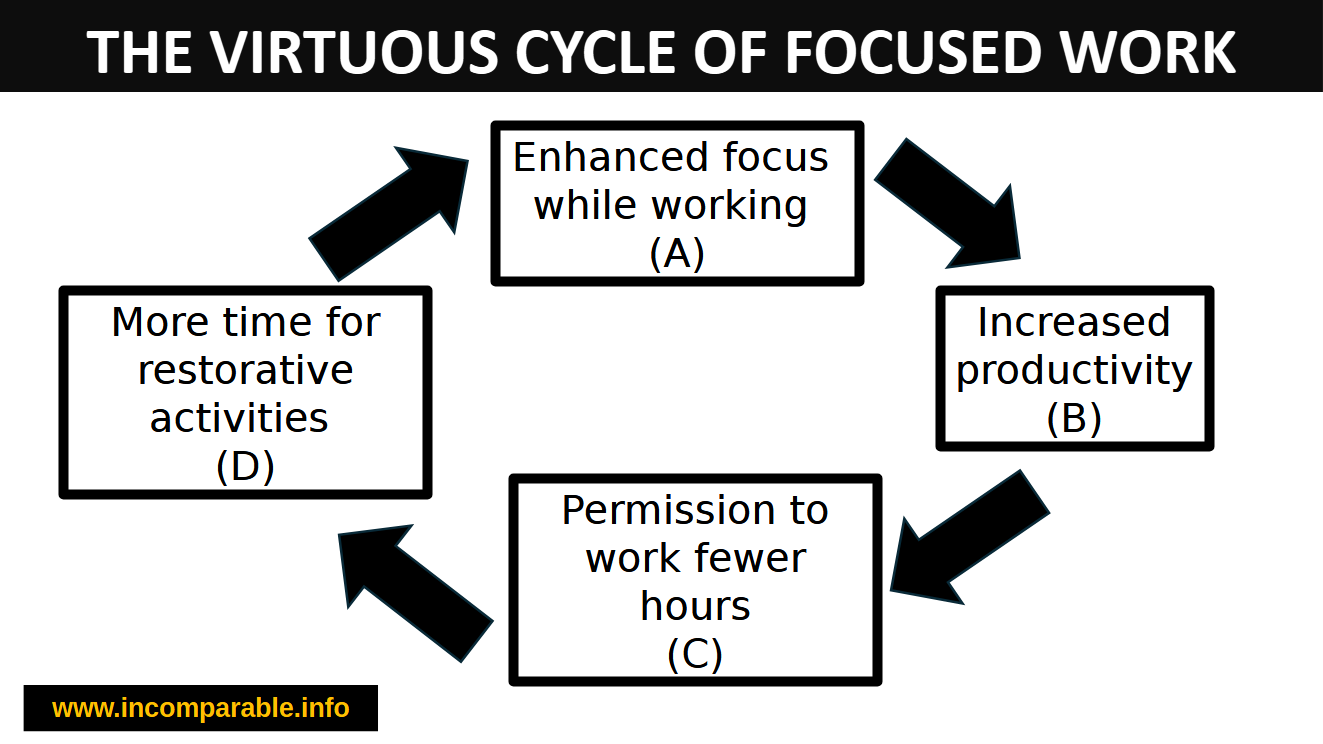
In the following weeks, I was also more productive than before the experiment, though not as spectacularly.
Unfortunately, I had very unproductive days towards the end of the self-experiment. I wrote in my notebook: “When I went to the office late, and I was tired, my productivity wasn’t great, and I wasted my time at the office. At the same time, I stopped going to the gym as often, and missed walks because I felt I needed to work more, which has been the worst”.
I had this “need to work more” because I had too many things on my plate. I was not only doing the research for my PhD, but also writing part of a book chapter, and other “opportunities” (e.g., job openings) prompted me to work “more”. I started overworking, got tired, and couldn’t focus during those extra hours. Consequently, I wasted some of my time.
I even checked the news 3 days before the end of the self-experiment, which was something forbidden during the experiment. It was a Sunday, and I was at the office, extremely tired and lacking motivation. I hadn’t blocked the news on Sunday because I didn’t expect to be at the office on weekends! So, an easy, distracting activity (i.e., checking the news) was more appealing than a deep activity (i.e., writing a book chapter).
This is a pattern I have observed many times: If I am tired, lack motivation, or feel bad, the digital toys (if available) take over my attention.
In conclusion, not having a smartphone or the internet at home seems to have increased my productivity, but this statement should be qualified. Other variables were also at play, such as the activities I pursued in my free time and the amount of work I committed to.
Note that committing to do more work does not necessarily translate into feeling more productive based on my definition of productivity as having the sensation of making good use of my time.
Why did I expect my sociality to improve?
I thought that not having an online alternative to face-to-face socialising or websites to visit when I was bored would make me more likely to interact with people nearby. Consequently, I expected to start more conversations with people I didn’t know, propose more social activities to do with others, and participate in more social activities organised by others.
Did my sociality really improve?
I reached the conclusion that my sociality did improve in the sense that I did “more social things than before”. However, at the time, I considered the improvement wasn’t impressive.
As for productivity, the clearest improvement occurred in the first week of the experiment when I started many conversations with people I didn’t know at different places: at work, on my walks, and in cafés. This wasn’t very common at the time. I also participated in more social activities and proposed social activities to do with my new acquaintances. Curiously, one of them became one of my best friends in the UK, and we started playing table tennis, going for walks, having coffee, etc., during the experiment.
I also managed uncomfortable social situations better. For example, I had a very difficult phone conversation with one of my closest friends while I was at home. I didn’t feel well after that at all. I wrote: “It was one of these moments in which I would have been distracted by my phone”. However, instead of losing myself in the digital world, “I sat on the bed, thought about what had happened, and then I started to do things: I had dinner and went to dance salsa”.
During the remaining weeks, I continued to participate more in social activities, like eating out and attending a 3-day dance festival. I became more proactive socially, starting more conversations and proposing more plans than before.
One reason I was more social might have been that I was more attentive to social cues because I wasn’t looking at my phone. I think the effect of this, although important, was probably small, as I wasn’t looking at my phone all the time before.
Another explanation could be that I was more social because smartphones and the Internet couldn’t replace face-to-face socialising. This sounds quite plausible to me. I think this, combined with the fact that I was less tired from processing less digital information, put me in a mood to be more social and start conversations with people I didn’t know.
Of course, another possibility was that I was more social because that was my hypothesis, and I wanted to find support for it!
Why did I expect an improvement in my well-being?
My expectation that I would be happier without the smartphone and the internet at home was a logical consequence of my two previous expectations. If I used my time at work more effectively, engaged in cool activities outside work, and were more socially competent, I would necessarily be happier.
Did my well-being really improve?
When evaluating this, I reached a strong positive conclusion:
“This is very clear! I’m happier without a smartphone and without an internet connection at home, and I have more time. I don’t feel bad about wasting my time. Of course, having a goal and living in agreement with my own values is great”.
Note that my conclusion that not having a smartphone or internet at home increases my happiness and well-being is based on personal values. I don’t want to waste my time. Using my laptop and smartphone to browse the internet makes me feel bad for wasting my time. Consequently, not having the option to waste my time this way and instead doing other activities made me feel happier.
I had a very vivid memory of that first week without my smartphone or internet at home. I remember the feeling of total relaxation and inner peace as I walked to the office early in the morning. I really felt like the happiest knowledge worker on Earth. In my notebook, I speculated that “not being overloaded with [digital] information in both my work and spare time(…) made me less tired and more productive at the beginning [of the self-experiment]”, which likely affected my well-being positively.
Decisions after the self-experiment
After the self-experiment, I made several decisions. These included
-
Sell my smartphone and continue with a mobile phone without internet.
-
Don’t install internet in the house I was about to move into, where I was going to live alone for 4 months while I finished my PhD thesis.
-
Be OK with using some social media if their use is minimal and for specific purposes I deeply value (e.g., finding out about dance events). Nevertheless, I didn’t use social media at all until more than 2 years later.
Because I made these decisions, I can evaluate whether the results of the self-experiment were sustainable or limited to just one month.
A 4-Month Extension: Using the Internet Even Less
One month after the 1-month experiment, I moved to a new house for four months. During this time:
I didn’t install internet in this house, and I continue to use a mobile phone without internet instead of a smartphone. Furthermore, I stopped going daily to the office and worked almost exclusively from home. Consequently, I used the internet even less during this time than during the 1-month self-experiment.
These four months were immediately before the submission of my PhD thesis in early January 2020. By then, other PhD candidates frequently asked me how I could conduct my research without internet access at home. Pretty easy. Most of the information I needed was already stored on my laptop. If I still needed any information from the internet, I just wrote it down in a notebook.
Some days, I went to the local library or a café for one hour and collected the information I needed. I also replied to emails during that time. This is the way I used the internet in the early days. A great advantage of this system is that I had a clear separation between deep work (e.g., writing and data analysis) and shallow work (e.g., replying to emails and collecting information).
I was very productive during those four months. Of course, this wasn’t only because I didn’t have a smartphone or internet connection at home. I wanted to submit my thesis within 3 years of starting it, and I had only the last 4 months left. However, I didn’t overwork during that time and was extremely relaxed. In fact, I was frequently asked how I could be so relaxed just before submitting my thesis.
My relaxed attitude was likely caused by two factors. First, I had already done most of the work for my thesis. Yes, there were important pieces of work still to be done, but I had already written most of the thesis. Second, I was confident that my work system would make me finish on time. Apart from my limited internet access, my work system also included a daily walk through the nice woodland behind my house. This often boosted my creativity and replenished my attention, which was very valuable for keeping me writing.
I also considered it the best period of the three years I worked on the thesis in terms of sociality and happiness. Apart from the internet disconnection, the improvement in my social life could also have been driven by the fact that I knew more people at the end, or by the absence of housemates, which led me to invite more people over. However, it is clear that an important part of my sociality at the time was with people I met during my months of internet disconnection.
The improvement in my happiness was likely again caused by the congruence between my personal values and lifestyle. Another contributing factor could have been that I was anticipating the reward of finishing my thesis and the exciting plans I have for the day after.
A natural experiment during lockdown
After submitting my thesis, I continued living without a smartphone, but for various reasons, I started living in places with internet access. However, a natural experiment on living without internet access at all for two weeks took place in April 2020. The internet stopped working at home, and because it coincided with the UK’s first lockdown, I couldn’t access it at all.
For me, this was fantastic. I have never been more productive in my life than in those two weeks!! I had massive to-do lists and was able to do it all! My to-do list included:
-
a morning routine with exercise at home,
-
writing 6-7 hours a day,
-
going for a walk at noon,
-
collecting data for a self-experiment on diets,
-
practicing my English pronunciation by recording and listening to myself,
-
studying salsa footwork,
-
journaling,
-
reading,
-
and many other small things.
Of course, I was so productive because I took the lockdown and the lack of internet access as an opportunity for self-improvement. However, the lack of internet access made it less likely that I would deviate from my path, as there were fewer temptations to seek easy entertainment.
Obviously, my sociality did not improve during those two weeks without internet during the lockdown, but I was quite happy.
What can we learn from these experiences?
I think the most important thing we can learn from these experiences isn’t the conclusions about the effects of the internet on my productivity, sociality, and well-being, but the methods I used to reach them. Often, we feel that something is wrong or that we could do better. We have intuitions about what is failing, but we procrastinate action. Consequently, the problems continue with us.
Doing a small self-experiment in which we add, remove, or replace something from our lives for a predefined period is a great way to understand our problems and find solutions. Through careful observation of the effects of the change, we sometimes find out that the solution is quite simple. Other times, we will discover that the problem is more complex than our intuitions. The information we gather from this type of experiment is invaluable when we try to help ourselves get on the right track to solve or improve at something.
Many people feel that digital technologies are damaging something in their lives. They might find they don’t pay enough attention to their children due to the constant notifications from technology; feel inadequate while passively browsing their friends’ news feeds on social media; or miss the time when they had more time to do cool offline activities. If this is your case, doing a self-experiment like what I did could help you to find your own solutions.
Update: How I Use the Internet Today
The initial 30-day self-experiment and the 4-month extension both occurred in the second half of 2019. After these experiences, I moved quite a lot, shared accommodation, and worked from home (including video calls). So, I started using the internet at home in January 2020.
The first months with the internet back at home weren’t much of a problem. Many of my bad internet habits had gone – I also socialised and went to Latin dance events a lot, didn’t have social media, and had the explicit goal of not following the news at all that year. All of these things likely helped.
As you know, 2020 was the year of COVID, and I had a number of personal problems in the second half of the year on top of the restrictions. This was quite challenging for my digital minimalist goals. Sadly, I went back to passively watch a lot of YouTube videos at some point – probably as a way to cope with loneliness. This makes me conclude that a temporal detox is not a permanent solution, at least, not for me (and other people with poor self-control). More intentionality is needed for long-term success.
One solution was using internet blockers. Cold Turkey Blocker, in particular, helped me a lot (I’m a big fan), but I didn’t use it all the time (my fault) – so the problem kept coming back.
Regarding the smartphone, I haven’t had one for 5 years, from 1st July 2019 until September 2024, when I went on several trips to big cities abroad. I’m very happy not to have used a smartphone for all these years, and I miss that lifestyle!
Nevertheless, I have found a healthy way to use the Smartphone: I use the Minimalist Phone App to block the worst distractions (browser, email, YouTube, Play Store), turning the phone into black and white, and using only WhatsApp (with no notifications) and Google Maps as apps that require internet to work. Moreover, I have stopped working from home (I now go to a co-working space), and consequently, I no longer have an internet connection at home again.
By the way, I’m loving it! 🙂
About the Author
Ángel V. Jiménez is passionate about intentional living, scientific psychology, and the analysis of human behavior from an evolutionary perspective. He earned his PhD at the University of Exeter (UK), where he studied processes of status acquisition and interpersonal influence, with particular emphasis on the role of prestige in social learning. After completing his doctorate, he conducted postdoctoral research at Brunel University London and the University of Exeter. He currently teaches research methods for psychology.
Through this website, he shares practical, research-informed, and reflective content on intentional living and psychology, helping readers better understand human nature and make more deliberate choices in an increasingly complex and distracted world.

References
Jiménez, A.V. (2026). The Diffusion of Mobile Phones and the Internet: A personal Perspective. Incomparable.
Newport, C. (2019). Digital minimalism: Choosing a focused life in a noisy world. Penguin.
More Articles on Practical Philosophy

Did the Introduction of Facebook Cause a Rise in Depression and Anxiety?
Did the Introduction of Facebook Cause a Rise in Depression & Anxiety? It has become common to blame social media for the growing rates of depression and anxiety specially among young people over the past two decades. But… how can we be sure that social media caused...
