
Did the Introduction of Facebook Cause a Rise in Depression and Anxiety?
It has become common to blame social media for the rising rates of depression and anxiety among young people in the last two decades.
But…
How can we be sure that social media caused this increase in mental health issues—and that these trends didn’t simply happen to rise alongside each other?
To me, the most compelling evidence comes from examining the moment the first major social media platform emerged.
In this post, I walk you through research that provides causal evidence linking the introduction of Facebook to increases in depression and anxiety among university students.
In this Article...
F
G
A Natural Experiment: Facebook’s Rollout Across American Universities
Between 2004 and 2006, Facebook—the first major social media platform—was gradually introduced across American universities, not all at once but campus by campus. This staggered rollout created a unique opportunity to study the platform’s effects on mental health.
This opportunity was taken by economists Luca Braghieri, Ro’ee Levy, and Alexey Makarinthat, who examined mental health trends before and after Facebook became available at 775 U.S. universities.
The researchers used data from 17 waves of the National College Health Assessment, which included a range of student variables such as:
- depressive symptoms
- use of mental health services
- anxiety
- eating disorders
- demographic details
- situational factors like living arrangements, drug use, and credit card debt
Proving Cause and Effect: The Difference-in-Differences Approach
To determine causality, the researchers used a statistical method called difference-in-differences—a technique widely used in economics to evaluate the impact of specific policies. This approach compares outcomes between similar groups that are and aren’t exposed to a particular change, such as a policy increasing the minimum wage or, in this case, the introduction of Facebook on a campus.
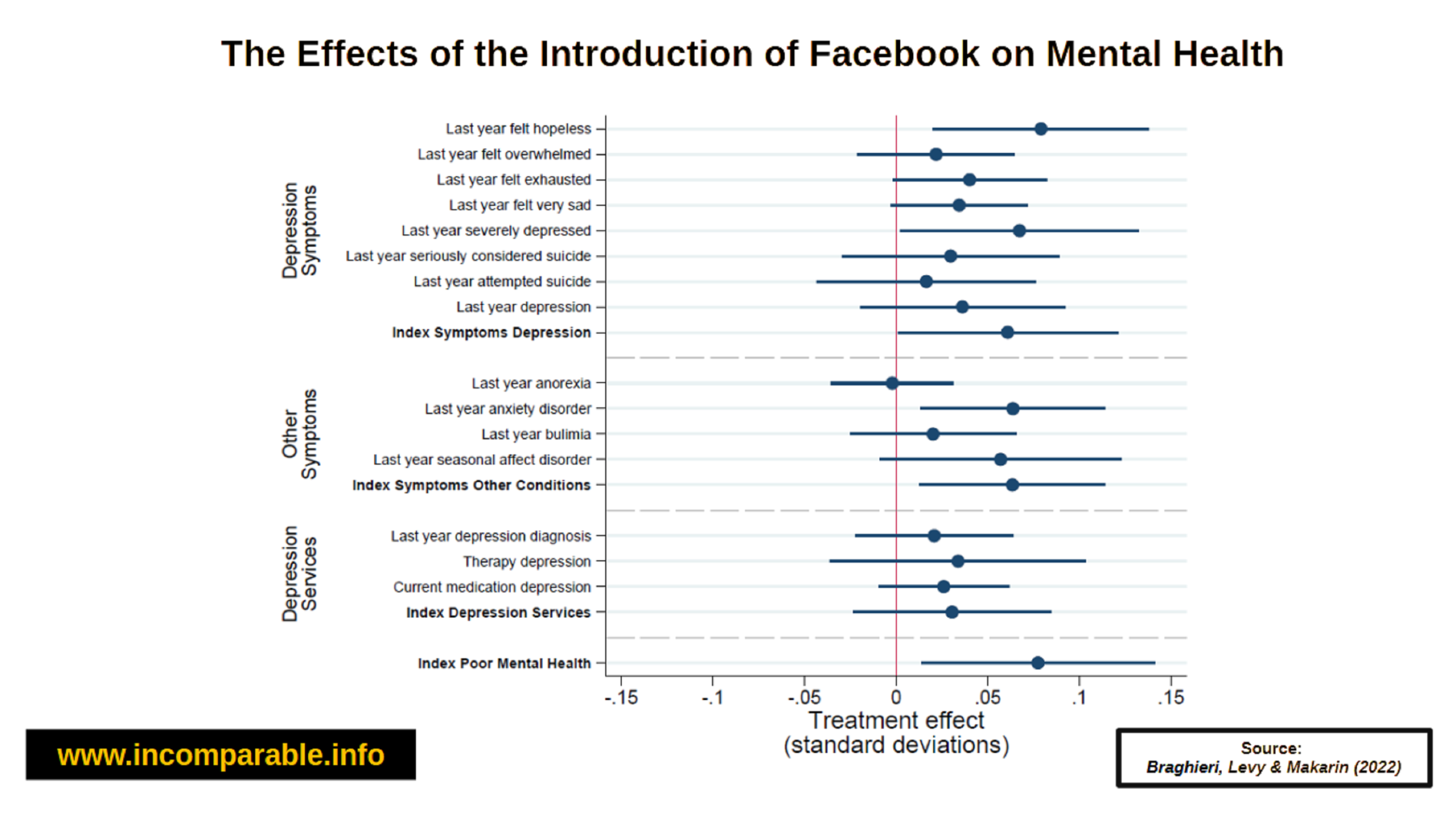
The results using the difference-in-differences approach were clear:
Facebook’s rollout caused a marked increase in mental health issues among students—specifically depression and anxiety.
Interestingly, it had no impact on other conditions such as anorexia, bulimia, or seasonal affective disorder.
Further Details (Click to Expand)
Each dot shows how the rollout of Facebook affected a specific mental-health outcome, comparing campuses that got Facebook earlier vs. later. Values to the right of zero mean symptoms increased; values to the left mean they decreased. The lines show the 95% confidence intervals around each estimate, and when they cross zero it means the effect is not statistically distinguishable from no impact. Indexes summarize the average effect across related symptoms to show broader patterns. See Braghieri, L., Levy, R., & Makarin, A. (2022). Social media and mental health for further details.
How Big Was the Impact?
The researchers estimated that the mental-health toll of Facebook’s introduction was roughly 22% of the distress caused by losing a job, and about 84% of the distress associated with having credit-card debt.
More specifically, they found that the percentage of students meeting criteria for depression and anxiety increased by 9% and 12%, respectively. These are relative increases. In absolute terms, both rose by about 2 percentage points:
Depression increased from roughly 25% to 27%, and anxiety from 16% to 18%.
Academic performance suffered as well: the share of students reporting that depression or anxiety impaired their studies increased by 3 percentage points, from 13% to 16%.
Why did the Introduction of Facebook Have a Negative Effect on Mental Health?
Researchers have proposed several reasons why Facebook’s arrival led to a noticeable decline in student mental health.
One of the most compelling explanations is that the platform’s introduction on university campuses increased unfavourable social comparisons among students.
Social media platforms like Facebook make it easy for users to compare their lives with those of others. Because people tend to share only the best parts of their lives online, many of these comparisons are upward—leading users to feel as though they’re falling short.
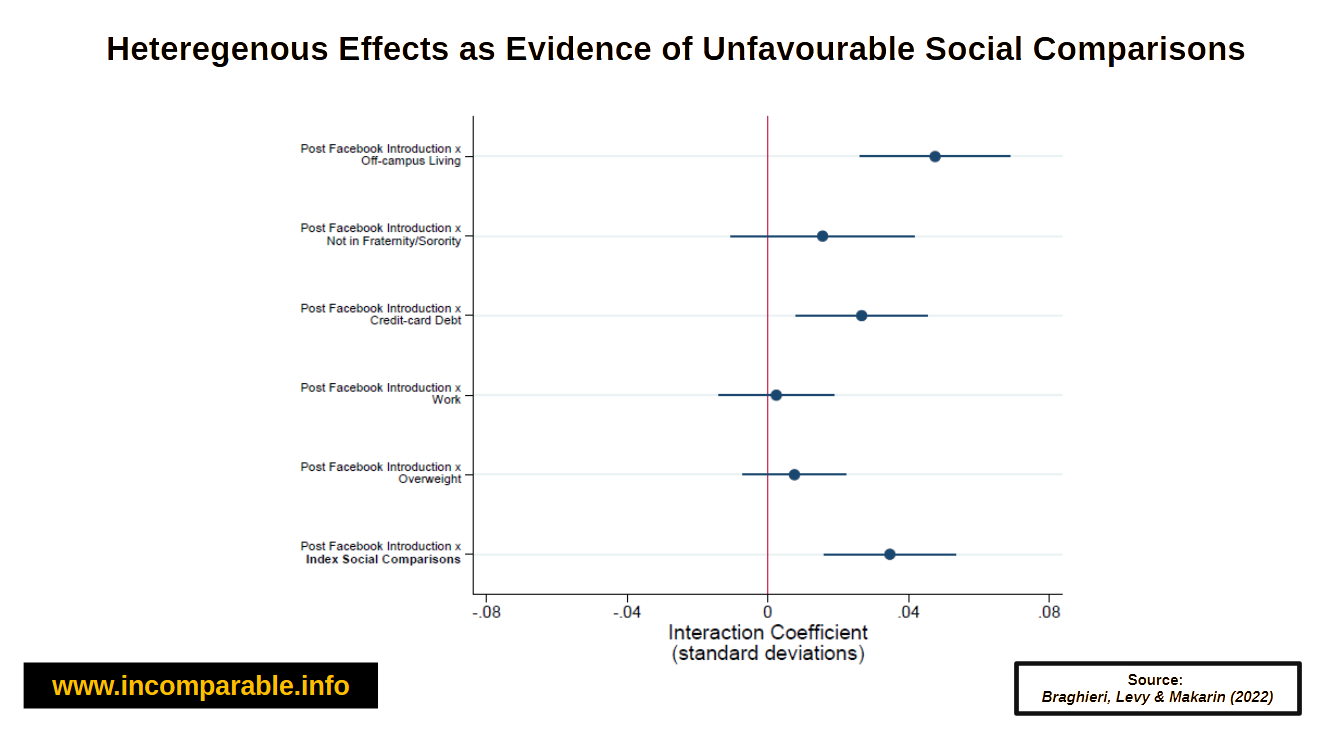
The researchers found particularly strong evidence for this mechanism. Students who were more socially isolated—such as those living off-campus or struggling with credit-card debt—were especially vulnerable to the negative effects of Facebook’s introduction on mental health.
These students were not only more negatively affected by Facebook’s introduction but were also more likely to overestimate the intensity of their peers’ social lives. For instance, they believed their classmates were drinking and partying far more than they actually were, which may have intensified feelings of exclusion or inadequacy.
How to read this figure (click to expand)
Each dot shows how Facebook’s introduction affected mental health for students with a characteristic linked to greater susceptibility to unfavorable social comparisons (e.g., living off-campus, having credit-card debt). Values to the right of zero mean Facebook had a stronger negative impact for that group; values to the left mean a weaker or opposite effect. The lines show the 95% confidence intervals around each estimate, and when they cross zero it means the interaction effect is not statistically distinguishable from no difference. The index at the bottom summarizes the overall pattern across all characteristics associated with susceptibility to unfavorable social comparisons. See Braghieri, L., Levy, R., & Makarin, A. (2022). Social media and mental health for further details.
What about Behavioural Disruption?
Another possible explanation is behavioural disruption. The arrival of Facebook may have changed how students used their time—leading to more procrastination, increased time wasting, reduced physical activity, and lower academic performance. All of these behaviours can contribute to elevated stress, anxiety, and depression.
This initially appears to be a strong possibility. Facebook’s user base on university campuses was around 85% at the time; students logged on an average of six times per day; and the platform was the ninth most visited website on the entire internet—even though it wasn’t yet available outside American universities.
However, the researchers did not find evidence supporting the behavioural-disruption hypothesis.
The problem does not appear to have been that Facebook distracted students too much. Instead, the issue seems to have been that it made them feel worse about their own lives compared with the positive portrayals of others.
Why Was Behavioural Disruption Not a Bigger Factor?
I find it quite surprising that behavioural disruption wasn’t a major contributor to the rise in mental health problems following the introduction of Facebook.
In my personal experience, it’s this disruption—constant distraction, habitual checking for updates, missing out on other parts of my life, and information overload—that has caused the most distress with digital technologies in the past. It even pushed me to take drastic steps, such as getting rid of all my social media accounts, my smartphone, and even the internet at home!
Behavioural disruption feels very tangible to me, whereas the effects of social comparison have been perhaps more subtle. I suspect others—possibly including you—might relate to this as well.
However, we need to consider that Facebook back then was very different from the platform it is today. At the time, it was limited to students at U.S. universities. There were no “likes,” no red notification badges, no videos, no pages, no algorithmically ranked personal feeds, and no mobile access (whereas today the platform is mostly mobile).
This early version of Facebook lacked many of the features that now encourage compulsive use; it wasn’t designed to provide a continuous stream of engaging content or constant social feedback. In that sense, it seems reasonable that the platform at the time was more likely to prompt unfavourable social comparisons than to cause behavioural disruption.
What Are the Limitations of the Study?
One key limitation of the study is that the researchers did not have individual-level data on Facebook usage. This means they couldn’t determine which specific students were on Facebook or how much time each spent on the platform. Instead, the analysis focused on the broader mental health trends observed after Facebook was introduced at a university campus.
This is a limitation because it leaves important questions unanswered: Were the negative mental health effects more pronounced among heavy users, or did they affect non-users as well? If those who used Facebook the most experienced the worst outcomes, then the study’s overall estimates may understate the platform’s true impact. But without user-level data, we can’t say for sure.
That said, there’s also a strength to this broader approach. The arrival of a new social media platform doesn’t just affect those who use it. Even students who didn’t join Facebook could have been impacted—perhaps by feeling excluded, experiencing reduced face-to-face interaction, or encountering shifts in campus social dynamics, such as increased attention given to students who were more visible on the platform.
Another limitation is that the dataset used to measure students’ mental health does not contain information about their tendency to compare themselves to others. The study assumes that students with certain social disadvantages—such as living off campus—were engaging in upward social comparisons. Given the human tendency to make more upward than downward social comparisons both in general (as shown in meta-analytic research) and when using social media, this assumption seems plausible. However, direct evidence is lacking in this study.
Why Is This Study Still Relevant Today?
One major advantage of studying early Facebook data is that it offers a rare natural experiment: a clear contrast between students exposed to social media for the first time and those who hadn’t used it at all. In today’s hyper-connected world, finding such a clean comparison group is nearly impossible.
However, the data come from two decades ago, and much has changed since then. Facebook itself has evolved significantly, and other platforms like Instagram, TikTok, and X (formerly Twitter) have entered the scene. Today’s social media landscape includes features that didn’t exist back then: algorithm-driven feeds, targeted advertising, likes and reactions, video content, influencer culture, filters, and even AI-generated images and videos.
Although these changes have occurred, social media still encourages comparison between users—and this element, according to many researchers, is one of the clearest pathways through which social media affects mental health. In fact, a recent meta-analysis synthesising findings from 48 experimental studies concluded that unfavourable social comparisons negatively affect users’ body image, subjective well-being, mental health, and self-esteem.
Furthermore, new social media features have likely intensified the harmful effects of unfavourable social comparisons. Take filters, for example. Their widespread use to enhance appearance exposes people to even more curated and idealised versions of others, amplifying the negative impact on body image. The increasing use of AI-generated body images will almost certainly have a similar effect.
Is Behavioural Disruption a Greater Factor Today?
Although behavioural disruption was not a major cause of the increase in mental health problems during the staggered introduction of Facebook in U.S. universities, it is clearly a key contributor today.
The average social media user visits 6.75 platforms per month, spending 18 hours and 36 minutes per week on these sites—roughly equivalent to an entire waking day. The obvious consequence of spending extra time on social media and other digital activities is a reduction in offline activities such as playing sports, engaging in face-to-face interactions, and spending time in nature. Another consequence is technological interference while people are supposed to be engaged in other activities such as studying, deep working, or in-person social interaction.
Why would behavioural disruption be more likely today than during the initial rollout of Facebook across American universities? The likely cause is the compounded negative effect of accumulating digital clutter, especially once social media became available on mobile phones. This has created a society in which there is no rest from the digital world: people are always reachable, and distraction is always available to cover up even the slightest hint of boredom or mental discomfort.
Conclusion
The reviewed study clearly shows that the introduction of Facebook at American universities between 2004 and 2006 had a significant negative impact on students’ mental health. The intensification of upward social comparisons through Facebook use seems to have been the main mechanism underlying the rise in mental health problems among students at the time. The evidence does not suggest that Facebook’s initial introduction led to an increase in procrastination, distraction, or reduced physical activity.
Nevertheless, both mechanisms—social comparison and behavioural disruption— are now simultaneously affecting mental health today.
Ángel V Jiménez
About the Author
Ángel V. Jiménez is passionate about intentional living, scientific psychology, and the analysis of human behavior from an evolutionary perspective. He earned his PhD at the University of Exeter (UK), where he studied processes of status acquisition and interpersonal influence, with particular emphasis on the role of prestige in social learning. After completing his doctorate, he conducted postdoctoral research at Brunel University London and the University of Exeter. He currently teaches research methods for psychology.
Through this website, he shares practical, research-informed, and reflective content on intentional living and psychology, helping readers better understand human nature and make more deliberate choices in an increasingly complex and distracted world.

References
These are the materials consulted to prepare this article. Interested readers can review them to delve deeper into the topics discussed.
Main Study
Braghieri, L., Levy, R., & Makarin, A. (2022). Social media and mental health. SSRN.
Books
Alter, A. (2017). Irresistible: Why we can’t stop checking, scrolling, clicking and watching. Random House.
Newport, C. (2019). Digital minimalism: Choosing a focused life in a noisy world. Penguin.
Newport, C. (2016). Deep work: Rules for focused success in a distracted world. Hachette UK.
Blog Posts
Hass.N. (2006). In Your Facebook.com. The New York Times. Accessed on 3/12/2025.
Harrington, M. (2005). 85% of College Students use FaceBook.Tech Crunch. Accessed on 3/12/2025
Jiménez, A.V. (2026). Living Better with Less Technology: A Life-Changing Self-Experiment. Incomparable.
Jiménez, A.V. (2026). The Diffusion of Mobile Phones and the Internet: A personal Perspective. Incomparable.
Kepios (2025). Global Social Media Statistics. Data Reportal. Accessed on 5/12/2025
Scientific Publications
Anderson, I. A., & Wood, W. (2021). Habits and the electronic herd: The psychology behind social media’s successes and failures. Consumer Psychology Review, 4(1), 83-99
Appel, H., Gerlach, A. L., & Crusius, J. (2016). The interplay between Facebook use, social comparison, envy, and depression. Current Opinion in Psychology, 9, 44-49
Baker, A., Callaway, B., Cunningham, S., Goodman-Bacon, A., & Sant’Anna, P. H. (2025). Difference-in-Differences Designs: A Practitioner’s Guide. ArXiv preprint.
Brailovskaia, J., Ströse, F., Schillack, H., & Margraf, J. (2020). Less Facebook use – More well-being and a healthier lifestyle? An experimental intervention study. Computers in Human Behavior, 108, 106332.
Dongjun, Z., Mingyue, W., Xinqi, L., Lina, W., Jiali, W., & Mengyao, J. (2025). Trends in depressive and anxiety disorders among adolescents and young adults (aged 10-24) from 1990 to 2021: A global burden of disease study analysis. Journal of Affective Disorders, 387, 119491.
Gerber, J., Wheeler, L., & Suls, J. (2018). A social comparison theory meta-analysis 60+ years on. Psychological Bulletin, 144(2), 177–197
Junco, R. (2012). Too much face and not enough books: The relationship between multiple indices of Facebook use and academic performance. Computers in Human Behavior, 28(1), 187-198.
McComb, C. A., Vanman, E. J., & Tobin, S. J. (2023). A Meta-Analysis of the Effects of Social Media Exposure to Upward Comparison Targets on Self-Evaluations and Emotions. Media Psychology, 26(5), 612-635.
Meier, A., Reinecke, L., & Meltzer, C. E. (2016). “Facebocrastination”? Predictors of using Facebook for procrastination and its effects on students’ well-being. Computers in Human Behavior, 64, 65-76.
Midgley, C., Thai, S., Lockwood, P., Kovacheff, C., & Page-Gould, E. (2020). When everyday is a high school reunion: Social media comparisons and self-esteem. Journal of Personality and Social Psychology, 121(2), 285–307.
Sagioglou, C., & Greitemeyer, T. (2014). Facebook’s emotional consequences: Why Facebook causes a decrease in mood and why people still use it. Computers in Human Behavior, 35, 359-363.
Sbarra, D. A., Briskin, J. L., & Slatcher, R. B. (2019). Smartphones and Close Relationships: The Case for an Evolutionary Mismatch. Perspectives in Psychological Science, 14(4), 596-618.

